

Workplace Conflict Resolution Strategies: The Definitive 2026 Guide for Leaders
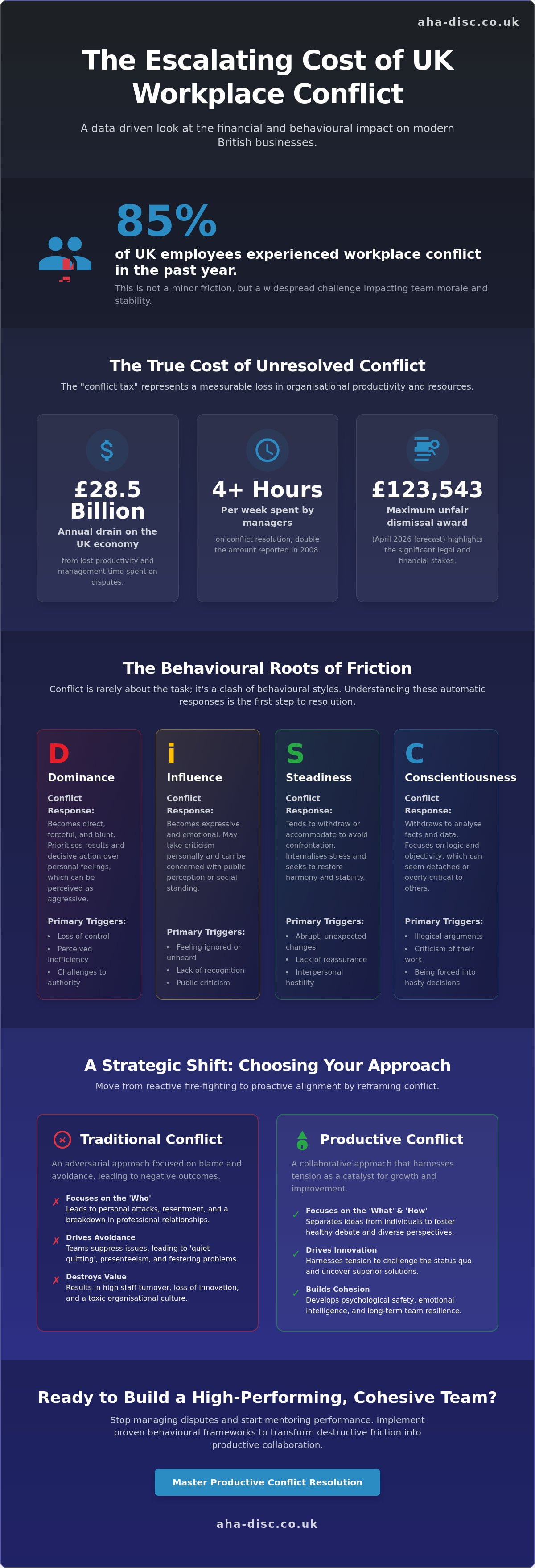
85% of UK employees experienced workplace conflict in the past year. This isn’t just a minor friction; it’s a £28.5 billion drain on the national economy in lost productivity and management time. With the maximum compensatory award for unfair dismissal rising to £123,543 in April 2026, the cost of getting it wrong is now a significant boardroom risk. You likely feel the pressure of these figures whilst managing a team where digital misunderstandings and hybrid work tensions are becoming the norm. Implementing robust workplace conflict resolution strategies is no longer a luxury for the few. It’s a critical requirement for any leader who values stability and performance.
We understand that managers often feel ill-equipped to handle difficult conversations, especially with the Vento bands for injury to feelings now reaching up to £62,900. This guide promises to change that by providing the behavioural frameworks and practical templates you need to transform tension into productive collaboration. You’ll learn how to master the Everything DiSC Productive Conflict model and the Five Behaviors framework to reduce staff turnover and foster psychological safety. We’ll preview how to move from reactive fire-fighting to a culture of high-standard, proactive alignment.
Key Takeaways
- Redefine conflict as a behavioural misalignment rather than a management failure to protect organisational culture and prevent high staff turnover.
- Master workplace conflict resolution strategies by identifying the specific “Conflict Triggers” unique to D, i, S, and C personality styles.
- Shift from traditional avoidance to “Productive Conflict” to harness tension as a driver for innovation and high-performance collaboration.
- Implement a structured manager’s template that prioritises objective preparation and the establishment of psychological safety during difficult conversations.
- Scale resolution efforts by integrating Everything DiSC Productive Conflict training to build long-term team cohesion and emotional intelligence.
What is Workplace Conflict? Defining Resolution in the Modern UK Office
Workplace conflict is the struggle between incompatible goals, differing values, or clashing behavioural styles whilst working toward a common objective. It isn’t a sign of organisational failure, but rather a natural byproduct of diverse teams striving for excellence. However, the distinction between healthy debate and destructive personality clashes is critical. Healthy friction focuses on the ‘what’ and ‘how’ of a project, driving innovation through diverse perspectives. Destructive conflict targets the ‘who’, leading to resentment that quickly poisons a team’s culture. Leaders acting as Master Mentors must identify early warning signs, such as decreased communication or subtle shifts in team dynamics, before these issues escalate.
Adopting proactive workplace conflict resolution strategies ensures that tension is channelled into productive outcomes. By understanding the underlying psychological frameworks, managers can navigate these disputes with quiet confidence. This requires a shift from viewing conflict as something to be suppressed to seeing it as a behavioural alignment opportunity. Citing established conflict resolution methods helps leaders build a structured approach that balances empathy with professional standards.
The True Cost of Unresolved Conflict in 2026
The financial implications of ignoring friction are staggering. Managers now spend over four hours per week dealing with disputes, which is double the amount reported in 2008. This drain on management capacity is coupled with the rise of ‘quiet quitting’ and presenteeism, where staff are physically present but mentally disengaged. With Statutory Sick Pay now at £123.25 per week and payable from day one as of April 2026, the financial weight of conflict-related absence is immediate. The ‘conflict tax’ represents the measurable loss in organisational productivity caused by unresolved friction and the subsequent drain on management resources.
Informal vs Formal Resolution: When to Step In
Determining the tipping point for intervention is a vital leadership skill. Informal resolution is the preferred route for the majority of disputes because it preserves long-term professional relationships and avoids the rigidity of formal grievances. It allows for a human-centric approach whilst aligning with current UK employment standards. However, when a disagreement risks legal repercussions or involves discrimination, formal processes must be initiated. With the maximum compensatory award for unfair dismissal reaching £123,543 and ‘Vento’ bands for injury to feelings climbing to £62,900 in April 2026, the stakes for accurate and timely intervention are absolute. Leaders don’t just solve problems; they protect the organisation’s future by mastering the balance between empathy and regulation.
The Behavioural Roots of Friction: Why Different Styles Clash
Conflict in the modern office is rarely about the task itself. Instead, it’s often a clash of behavioural DNA. Whilst one person sees a direct challenge as a healthy part of the process, another may perceive it as a personal attack. Hybrid work models have complicated this further, with a reported conflict rate of 48.7% in these environments. Digital communication often strips away the nuance of tone and body language, leading to “boundary conflicts” and misunderstandings that escalate quickly. To constructively resolve conflict, leaders must first decode the specific behavioural triggers that drive these reactions.
Every individual has an “automatic” response to tension based on their DiSC style. These internal blueprints dictate whether someone will lean into a dispute or withdraw in frustration. Effective workplace conflict resolution strategies require managers to recognise these patterns in real-time. By understanding that a blunt email from a high-D colleague isn’t an act of aggression but a quest for efficiency, you can prevent unnecessary escalation and maintain team momentum.
Mapping DiSC Styles to Conflict Behaviours
- Dominance (D): These individuals often respond with direct, forceful, and blunt communication. They prioritise results over feelings and may become impatient or demanding when challenged.
- Influence (i): Expressive and emotional, the i-style may take professional disagreements personally. They often resort to verbal outbursts or attempt to gloss over the issue to regain social approval.
- Steadiness (S): Naturally conflict-averse, the S-style will often accommodate others to keep the peace. However, this outward compliance can mask a deep-seated resentment that eventually leads to passive-aggressive behaviour.
- Conscientiousness (C): Driven by logic and accuracy, the C-style becomes defensive when their work is questioned. They may withdraw into data and focus on being “right” rather than finding a fast resolution.
The Role of Agile EQ in De-escalation
Success in resolving disputes depends on social agility. This is the ability to “stretch” beyond your natural comfort zone to meet the needs of the situation. Instead of reacting with an automatic habit, employees with high emotional intelligence can choose an intentional response. Everything DiSC Agile EQ supports conflict resolution by providing the psychological map needed to navigate these interpersonal stretches effectively. When a team member learns to pause and assess whether a situation requires empathy or firm logic, the entire culture shifts toward high achievement. If you want to empower your team with these skills, consider exploring our Everything DiSC Facilitator training to build a more resilient workforce.
Traditional vs Productive Conflict: Choosing Your Strategy
Many leaders view conflict as a fire to be extinguished. However, high-performing organisations treat it as fuel for innovation. This paradigm shift defines “Productive Conflict.” It’s not about the absence of tension, but the presence of constructive debate that prioritises the mission over the ego. When teams avoid friction, they often fall into a trap of stagnation where the best ideas are never voiced. Adopting sophisticated workplace conflict resolution strategies allows managers to harness this energy rather than merely suppressing it.
To navigate these dynamics effectively, you must choose a tactical approach that fits the specific business context. The Thomas-Kilmann Conflict Mode Instrument (TKI) identifies five primary modes: Accommodating, Avoiding, Collaborating, Competing, and Compromising. Mastering these Conflict Resolution Strategies for Leaders ensures you don’t default to a single, comfortable style that might be inappropriate for the crisis at hand. For instance, whilst collaboration is often the ideal, a high-stakes emergency might require a “Competing” stance to ensure safety or compliance.
The Comparison Table: Which Strategy Fits the Situation?
| Strategy | Time Sensitivity | Relationship Importance | Danger Zone |
|---|---|---|---|
| Accommodating | High | High | Unspoken resentment builds over time. |
| Avoiding | Low | Low | Small issues fester into major grievances. |
| Collaborating | Low | High | Analysis paralysis on minor decisions. |
| Competing | High | Low | Significant damage to team trust. |
| Compromising | Medium | Medium | Sub-optimal “middle ground” results. |
Building Trust as the Foundation for Resolution
Trust is the anchor of any successful resolution. Patrick Lencioni’s model warns against “Artificial Harmony,” a state where team members appear to agree but harbour deep-seated disagreements. This is more dangerous than open conflict because it prevents genuine commitment to decisions. Moving a team from mean-spirited politics to mission-driven debate requires vulnerability-based trust. This is the prerequisite for healthy, unfiltered debate about ideas.
Linking resolution success to The Five Behaviors: Team Development framework helps leaders build this foundation. When employees feel safe enough to be vulnerable, they no longer feel the need to be defensive during disputes. They shift their focus from protecting their “rightness” to achieving the collective goal. This transformation reduces the need for formal intervention and fosters a culture where “Productive Conflict” becomes a competitive advantage for the business.
The Manager’s Master Template for Resolving Workplace Disputes
Theoretical knowledge is useless without a practical framework for execution. Whilst legalistic approaches often focus on assigning blame, effective workplace conflict resolution strategies prioritise behavioural alignment and future performance. This master template provides a structured pathway to move from friction to focus. It’s designed for leaders who want to resolve issues before they escalate into the £10,000 to £25,000 legal fee range typically associated with straightforward unfair dismissal claims in the UK.
- Step 1: Preparation. Gather the objective facts and review the DiSC profiles of the individuals involved. Use your EPIC Administrator Account to pull comparison reports that highlight potential friction points between their styles.
- Step 2: The Opening. Set the stage by creating a safe, neutral space. Maintain your authority whilst demonstrating a genuine desire to find a solution that benefits the whole team.
- Step 3: Exploration. Move beyond the surface-level “what” of the disagreement. Ask open questions to uncover why the issue matters to each party and how it affects their productivity.
- Step 4: Co-creation. Don’t simply dictate the solution. Encourage the parties to develop a shared commitment to specific behavioural changes that they both find acceptable.
- Step 5: Follow-up. Schedule a review meeting for exactly 14 days after the initial conversation. This ensures the resolution sticks and prevents resentment from festering in the shadows.
The ‘Difficult Conversation’ Script Template
Reducing defensiveness starts with the first sentence. Avoid accusatory language that triggers an automatic “fight or flight” response. Use opening phrases like, “I’ve noticed some tension in our recent project meetings, and I want to understand your perspective on how we can improve collaboration.” This signals empathy without conceding your position as a leader. During the dialogue, employ active listening and mirroring techniques. Repeat back the essence of what the employee has said, starting with, “So, what I’m hearing is…” This validates their perspective and ensures total clarity before moving to the resolution phase. Close every meeting by documenting the agreed action plan in a follow-up email to prevent “selective memory” amongst the participants.
Facilitating Between Two Team Members
When two high-achievers clash, your role is that of a neutral facilitator rather than a judge. Set firm ground rules before the session begins: no interruptions, a focus on current behaviours rather than past grievances, and a commitment to professional language. One of the most powerful workplace conflict resolution strategies is the use of Everything DiSC Comparison Reports. These reports show both parties exactly where their styles diverge naturally, which helps de-personalise the conflict. It shifts the narrative from “you are the problem” to “our styles clash here, so how do we adapt?”. If you’re ready to lead these sessions with confidence, our Everything DiSC Facilitator Training provides the tools needed to transform team tension into a competitive advantage.
Scaling Conflict Resolution: Transforming Tension into Team Cohesion
Sustainable success requires moving beyond individual interventions to building a proactive culture. In 2026, the most resilient UK businesses are those that treat friction as a strategic asset rather than a liability. By embedding workplace conflict resolution strategies into the very fabric of your leadership development, you stop fire-fighting and start innovating. Everything DiSC Productive Conflict training serves as the cornerstone of this transformation. It provides a common language for teams to discuss their automatic responses and choose more effective behaviours whilst under pressure.
Integrating these frameworks into your 2026 leadership programme ensures that every manager possesses the social agility required for modern oversight. This isn’t a one-off event; it’s a long-term commitment to organisational health. The Academy of High Achievers Ltd, a Wiley Diamond award-winning partner, specialises in this high-level integration. We help you bridge the gap between psychological theory and commercial application through the Catalyst™ learning experience. This approach ensures that the value proposition of improved performance is never lost in technical jargon.
Becoming a Certified Conflict Facilitator
Bringing expertise in-house is the most efficient way to scale these cultural shifts across a large workforce. For HR and L&D professionals, becoming a specialist in these frameworks elevates your status to that of a strategic business partner. You gain the autonomy to run internal workshops, debrief comparison reports, and resolve disputes at the source. Accessing Everything DiSC Facilitator Training empowers you to lead your organisation toward a more cohesive and productive future with the quiet confidence of an industry expert.
Next Steps: Auditing Your Team’s Conflict Health
Before implementing new systems, you must understand your current baseline. Ask your team these critical questions to gauge their comfort with healthy debate: Do we feel safe enough to challenge the status quo? Are disagreements focused on ideas or personalities? Do we walk away from meetings with genuine commitment? If the answers suggest a culture of artificial harmony, it’s time to act. You can use EPIC credits to roll out assessments across the entire organisation, providing data-driven insights into your team’s conflict dynamics. For expert guidance on building a high-achievement culture, contact the Academy of High Achievers Ltd for a strategic consultation and start your journey toward productive collaboration today.
Building a Future of Productive Collaboration
Transforming tension into a commercial advantage requires more than just policy; it demands behavioural mastery. You’ve seen how decoding DiSC styles and using a structured template can prevent the escalating legal risks of 2026, where employment tribunal awards for unfair dismissal now peak at £123,543. By moving away from “artificial harmony” and embracing the Lencioni model of vulnerability-based trust, you create a culture where healthy debate thrives. This shift doesn’t just reduce staff turnover; it unlocks the human potential necessary for high achievement.
Adopting these workplace conflict resolution strategies ensures your organisation remains resilient and high-performing in a complex hybrid landscape. As a Diamond award-winning Wiley partner, the Academy of High Achievers provides expert UK-based facilitator training to help you embed these skills permanently within your leadership team. Discover how Everything DiSC Productive Conflict can transform your team and turn friction into your greatest asset for innovation. You now have the frameworks to lead your achievers toward a more cohesive, high-standard future.
Frequently Asked Questions
What is the most effective workplace conflict resolution strategy?
Collaboration is generally the most effective strategy for high-value disputes because it seeks a “win-win” outcome that preserves relationships and addresses the root cause of friction. Whilst other modes like competing or accommodating have their place in emergencies, collaboration ensures that workplace conflict resolution strategies lead to long-term innovation. It requires both parties to be transparent about their needs and willing to co-create a solution that aligns with organisational goals.
How do I handle a conflict with a manager who has a very different DiSC style?
Success lies in your ability to “stretch” your behaviour to meet your manager’s primary needs. If you’re an S-style reporting to a high-D manager, you should lead with results and be direct, whilst avoiding overly emotional explanations. Understanding their behavioural blueprint allows you to depersonalise their bluntness. By adapting your communication style, you reduce their stress triggers and create a more productive working relationship without compromising your own professional standards.
Is mediation the same as conflict resolution?
Mediation is a specific, facilitated method of conflict resolution that involves a neutral third party. Whilst conflict resolution is the broad goal of ending a dispute, mediation is a formal process often used when internal workplace conflict resolution strategies have failed. In 2026, a full-day mediation session typically costs between £900 and £2,300. It’s a structured intervention designed to help parties reach a voluntary agreement before the issue escalates to a formal grievance or tribunal.
Can workplace conflict ever be a positive thing for a team?
Yes, “Productive Conflict” is a vital driver for innovation and high-performance teams. When 85% of UK employees experience conflict, the objective isn’t to eliminate tension but to harness it for better decision-making. Healthy friction allows for the “clash of ideas” that prevents stagnation and groupthink. When managed correctly, these disagreements lead to higher levels of psychological safety and more robust solutions for the business.
How do I deal with ‘artificial harmony’ where everyone pretends to agree?
Artificial harmony is a sign of low trust and can be more damaging than open disagreement. To break this cycle, you must build vulnerability-based trust using frameworks like The Five Behaviors. Encourage team members to share their unfiltered opinions and reassure them that healthy debate is expected. Leaders should “mine for conflict” during meetings by asking for dissenting views to ensure that decisions are fully vetted before the team commits to them.
What are the 5 stages of conflict resolution for HR professionals?
The five stages include Preparation, Opening, Exploration, Co-creation, and Follow-up. Preparation involves gathering objective facts and reviewing behavioural profiles, whilst the Opening sets a safe space for dialogue. Exploration moves beyond what happened to why it matters. Co-creation involves developing a shared commitment to behavioural change, and the final Follow-up ensures the resolution sticks. This structured approach prevents resentment from festering and protects the organisation from costly tribunal claims.
How can I improve my emotional intelligence to handle difficult conversations better?
Improving emotional intelligence involves moving from “automatic” reactions to “intentional” responses. Utilising tools like Everything DiSC Agile EQ helps you identify your natural comfort zone and learn how to stretch into different mindsets when a situation demands it. This social agility allows you to stay composed and empathetic during high-pressure disputes. Practising active listening and mirroring techniques also ensures that the other party feels heard, which significantly lowers defensiveness during difficult conversations.
When should I involve a third-party mediator for a workplace dispute?
You should involve a mediator when a dispute has reached a deadlock or when there is a significant risk of a legal claim. With the maximum compensatory award for unfair dismissal reaching £123,543 in April 2026, external mediation is a cost-effective alternative to litigation. If a manager’s neutral facilitation isn’t resolving the issue, or if the parties involved no longer trust each other, a third party can provide the unbiased perspective needed to reach a settlement.